





| STOCK MARKET LIVE | BSE | NSE | ||||||
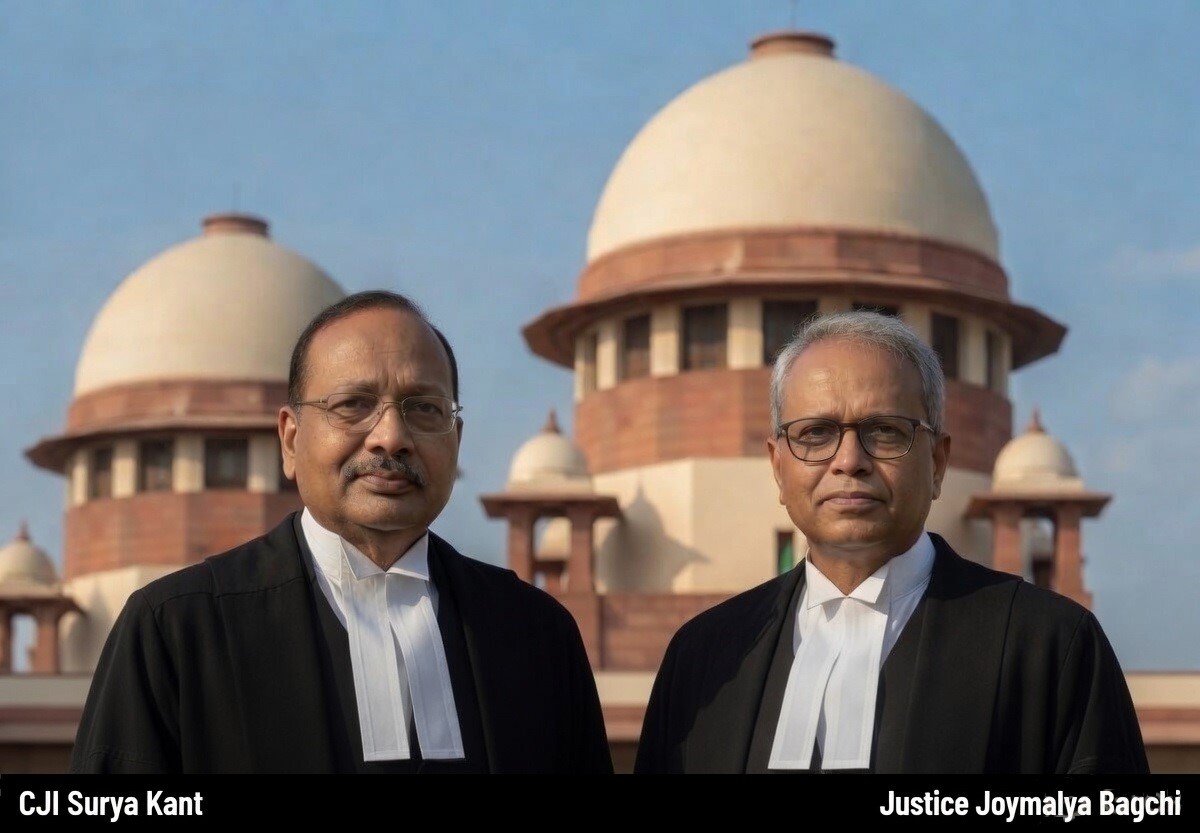
Bench of Chief Justice of India (CJI) Surya Kant and Justice Joymala Bagchi
NEW DELHI: In a landmark verdict with far-reaching implications for India’s electoral democracy, the Supreme Court on Wednesday upheld the constitutional validity of the Election Commission of India’s (ECI) Special Intensive Revision (SIR) of electoral rolls. The court ruled that the exercise “advances the constitutional imperative of free and fair elections” and falls squarely within the powers of the poll panel.
A two-judge bench comprising Chief Justice Surya Kant and Justice Joymalya Bagchi delivered the unanimous judgment while hearing a batch of petitions, including one filed by the Association for Democratic Reforms, challenging the SIR process, particularly the one implemented in Bihar. The petitions had questioned the legality of the intensive verification drive, arguing it imposed an undue burden on voters and could lead to large-scale deletions from voter lists.
The Supreme Court held that the SIR is legally tenable, proportionate, and does not violate the provisions of the Representation of the People Act, 1950. The bench observed that the ECI’s authority under Article 324 of the Constitution, which grants the Commission superintendence, direction, and control over elections, empowers it to undertake such revisions to ensure the integrity and accuracy of electoral rolls.
The documentation regime prescribed by the EC represented a considered exercise of its administrative discretion in furtherance of its Constitutional mandate, it said and added the EC is empowered to undertake a limited enquiry into citizenship for the purpose of satisfying itself as to eligibility for inclusion in the electoral roll.
According to the apex court, the credibility of the democratic process rests on the accuracy of the voter list. "We are unable to conclude that the impugned exercise is a process resorted solely for administrative convenience," the bench noted.
It said, "So long as the EC acts within the bounds of the statute, records reasons for recourse to the special power and does not transgress any express prohibition contained there, the SIR cannot be struck down as ultra vires merely because it adopts a procedure different from that applicable to an ordinary revision," and added that there were sufficient procedural safeguards to prevent arbitrary exclusion, the court said.
According to the verdict, if the EC is satisfied that a person does not deserve to be in the electoral roll, then it would be incumbent upon it to refer such an individual to the competent authority of the Centre for adjudication in accordance with law.
On the issue of persons deleted from the electoral roll on account of the Commission being of the opinion that they are not citizens, the verdict said the poll panel "shall refer such cases within four weeks to the Competent authority under the Citizenship Act, 1955, for adjudication of their citizenship".
"The Competent Authority shall take the necessary decision in accordance with law, preferably before the next Parliamentary, Assembly, Local Body elections, whichever is earlier, after giving notice and an opportunity of hearing to deleted individuals," it said.
In the event the competent authority holds that such deleted individuals are citizens, they shall be included in the electoral roll, it said.
The bench examined three questions -- whether the EC has the power to conduct an exercise like SIR, whether the inquiry under the SIR is founded on a legitimate purpose, and if the procedure adopted was contrary to or in violation of the provisions of the RPA It said the bench was satisfied that the object sought to be achieved by the SIR is directly connected to the constitutional goal of free and fair elections.
A key objection raised by the petitioners, including the NGO Association for Democratic Reforms (ADR), was that the SIR functioned as an "NRC-like process" with poll panel allegedly verifying citizenship, a power they argued vests solely with the central government.
The bench held that the EC has the authority to examine citizenship status only for the limited purpose of determining eligibility for the electoral roll.
The petitions were filed last year after the EC notified the SIR in Bihar ahead of the 2025 assembly elections. In the first phase, the poll panel initiated the SIR in Bihar, where 65 lakh names were removed from electoral rolls on grounds of rapid urbanisation and large-scale migration over the last four decades.
The Special Intensive Revision, which began in Bihar and was later extended to several other states, involves door-to-door verification, collection of documents, and scrutiny to remove duplicate, fake, or ineligible entries from voter lists. The ECI had justified the drive as a necessary step to purify electoral rolls ahead of crucial state assembly elections.
Opposition parties, including those from Bihar, had strongly criticised the SIR, alleging it was aimed at disenfranchising genuine voters, particularly from marginalised communities. However, the Election Commission maintained that the process included adequate safeguards, such as notices to affected voters and opportunities for appeals.
Reacting to the verdict, Chief Election Commissioner Gyanesh Kumar welcomed the judgment, stating it reinforces the Commission’s mandate to maintain clean electoral rolls. “This verdict strengthens democratic foundations by ensuring only genuine voters participate in the electoral process,” he said.
Legal experts described the ruling as a significant affirmation of the ECI’s institutional autonomy. Senior advocate Kapil Sibal, appearing for petitioners in related matters, said the court has struck a balance between voter rights and electoral purity.
The judgment is expected to pave the way for similar intensive revisions in other states. With general elections and multiple state polls on the horizon, the verdict assumes added significance in shaping the quality of India’s democracy.
Analysts believe the Supreme Court’s decision will help resolve long-standing concerns about bogus voting while setting clear boundaries on the ECI’s powers. As India prepares for the world’s largest democratic exercise, the ruling underscores that a credible voter list remains the bedrock of electoral integrity.
Reporter
Crisp, and to the point news coverage from India and around the world.
View Reporter News